

Armis Centrix™ for Asset Management and Security
Armis Centrix™ for Asset Management and Security is a comprehensive solution for organizations seeking to streamline their asset management processes while fortifying their security posture. Armis Centrix™ empowers organizations to efficiently gain deep situational awareness, track and manage their assets across diverse environments, ensuring optimal utilization and cost-effectiveness. Moreover, its robust security features provide real-time threat detection and response, safeguarding assets from potential cyber risks and vulnerabilities.
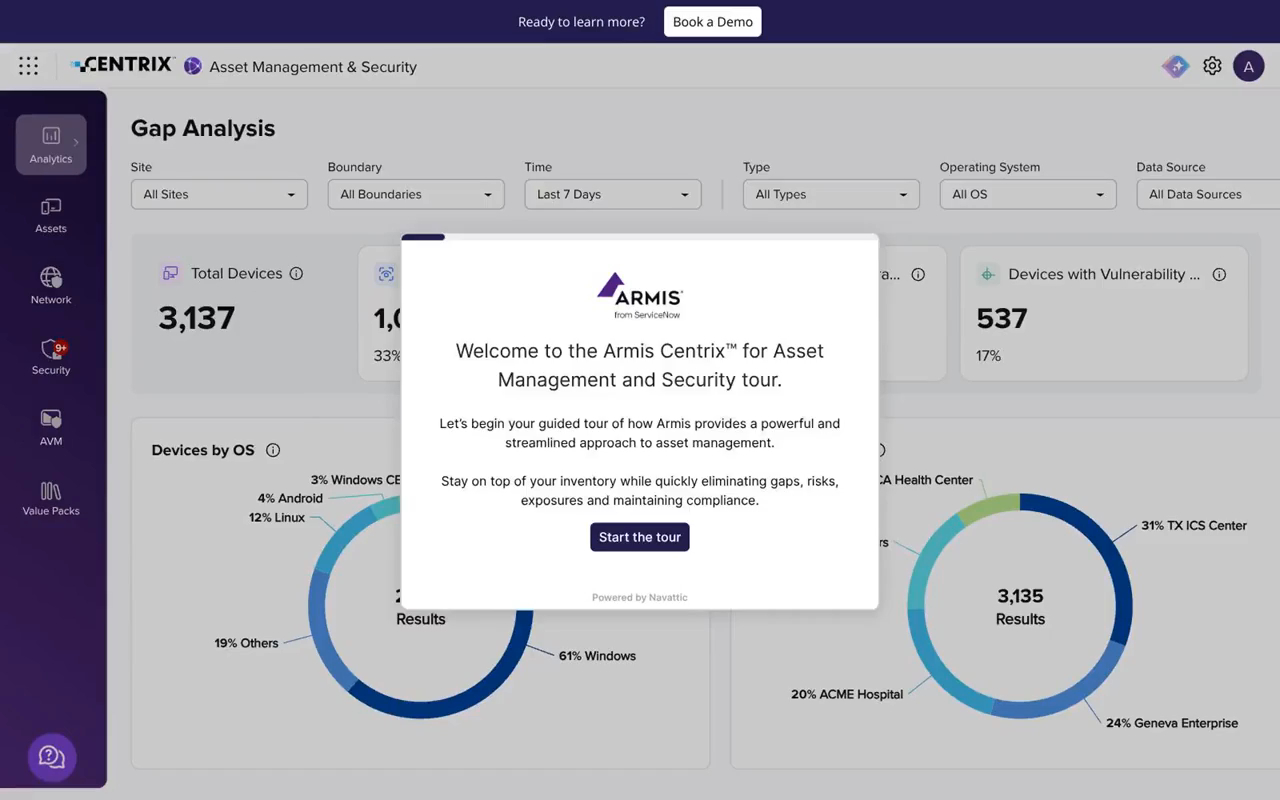

See, Protect and Manage Your Entire Attack Surface
Interactive Product Tour:
Armis Centrix™ for Asset Management and Security
Get a front-row seat to the industry’s leading asset management and security platform. Explore how Armis Centrix™ allows you to unify data into one view, neutralize risks and reclaim organizational capital. Click below to start your self-guided walkthrough.
Customer Stories
City of Jonesboro secures critical infrastructure and boosts cyber resilience with Armis Centrix™
“Armis gave us the complete visibility we needed across both IT and OT environments. We discovered 30% more assets than we thought we had, which has transformed how we secure our city’s critical infrastructure.”
— Jason Ratliff, Director of Information Systems, City of Jonesboro, Arkansas
The City of Jonesboro was grappling with blind spots in both IT and OT environments, lacking the visibility and control to manage a growing number of connected assets across critical infrastructure. With limited resources and mounting cyber risks, they needed a solution that could deliver clarity, efficiency, and protection at scale.
Armis Centrix™ delivered exactly that. By integrating with the city’s existing tools, enriching their CMDB, and enabling real-time monitoring across all environments, Jonesboro gained full situational awareness and improved its security posture. With 30% more assets discovered and threat detection enhanced across the board, the city now manages risk proactively — protecting residents and public services with confidence.

Global medical device leader boosts visibility, secures production, and simplifies M&A integration with Armis Centrix™
“Armis provides us with real-time visibility and control over our assets, allowing us to proactively manage security risks and improve our operational efficiency.”
— CISO, Medical Device Company
With operations spanning multiple regions and regular acquisitions, this global medical device company needed a unified, automated way to discover, manage, and secure its diverse asset landscape—including IT, IoT, and OT environments. Manual processes and fragmented tools were making it difficult to spot vulnerabilities and maintain regulatory compliance, especially across sensitive production sites.
By deploying Armis Centrix™, the organization achieved full visibility into all assets—including unmanaged and unsanctioned assets—while improving security and operational continuity. Real-time risk analysis now informs monthly KPIs, helping the company proactively monitor threats and simplify the onboarding of newly acquired businesses. With Armis, the team gained clarity, efficiency, and peace of mind—without disrupting production.

Global financial services leader hits 100% asset visibility with Armis
“Armis can cut through the noise and pinpoint the most vulnerable assets… It’s like finding the needles in the haystack first.”
— Manager of Security Engineering, Global Financial Services Organization
As part of a security maturity initiative, this global financial services organization turned to Armis to solve a persistent gap: incomplete visibility into its vast technical estate. Within weeks of deploying Armis, the team uncovered three to four times more assets than previously recorded in their CMDB, integrated nearly 20 security tools, and eliminated time-consuming manual processes. Today, they’ve achieved 100% visibility, streamlined risk-based prioritization, and confidently demonstrate compliance during audits—all while simplifying vulnerability management and fast-tracking M&A integrations.

More Than An Inventory. It's Intelligence.
Full Asset Inventory and CMDB Enrichment
Full Asset Inventory and CMDB (Configuration Management Database) are essential for maintaining real-time visibility and control over all connected assets across IT, OT, IoT, and medical environments. Armis Centrix™ discovers and classifies every asset, managed or unmanaged—providing comprehensive, continuously updated asset inventory. This enables accurate, dynamic configuration tracking and supports better decision-making, risk management, and compliance.
Attack Surface Management and Security Posture
Identify, monitor, and reduce risk across your digital footprint. Armis provides continuous, real-time visibility into all connected assets, helping organizations understand their true attack surface and prioritize risks based on exposure. This empowers security teams to strengthen their security posture with actionable insights and automated policy enforcement.
IT and Security Hygiene and Gap Analysis
Don’t let outdated systems put you at risk. Armis Centrix™ provides a clear understanding of what’s in your network, including physical and virtual assets and your software assets. It identifies old operating systems that are no longer supported and ensures that agent versions are up-to-date. With Armis Centrix™, you can monitor all of these in minutes, reducing your risk and avoiding the unnecessary cost that legacy systems entail.
No more guessing games. Armis Centrix™ helps validate the implementation of your existing security controls (EDR, vulnerability scanners, etc.) and identify gaps in deployment. It finds all assets that are not protected and helps remediate the issues quickly. Stay informed in real-time, track progress effortlessly, and take actions to enhance your security posture.
Internal and External Compliance Reporting
Internal and External Compliance Reporting requires accurate, up-to-date data on assets, vulnerabilities, and security controls. Armis streamlines compliance by continuously monitoring automatically mapping assets to relevant frameworks. Whether it’s NIST, CIS Controls, MITRE, GDPR, NIS2, or other regulations, Armis Centrix™ ensures your security standards are met, so you pass your audits with flying colors.
Network Segmentation and Enforcement
Network Segmentation and Enforcement are critical for limiting lateral movement and containing potential threats. Armis Centrix™ provides deep visibility into asset behavior and communication patterns, enabling organizations to design effective segmentation strategies and enforce policies based on real-time risk insights.
Threat Detection and Response
Armis Centrix™ provides intelligence-driven, cloud-based threat detection for devices operating outside of its “known good” baseline and Indicators of Compromise (IOCs). Anomaly Detection helps uncover complex attack patterns that traditional signature-based detection might miss by detecting anomalous asset behavior or network traffic. These multi-detection capabilities are critical to identify malicious or suspicious behaviors at their most granular level before they become a wide-scale attack.
Armis Centrix™ also collects and investigates threat forensic data before, during and after an incident to allow your security teams to make informed, data-driven prioritization security response decisions.
Armis Centrix™ for Asset Management and Security FAQs
What network security capabilities does Asset Management and Security offer?
Armis Centrix™ provides robust capabilities to help you secure your network and reduce your attack surface. Key features include:
- Network Threat Detection: Gain full visibility into network-based threats and indicators of compromise.
- Deep Packet Inspection: Visualize network communications between assets to identify risks and inform segmentation policies.
- High-Fidelity Anomaly Detection: Detect network threats with high accuracy by comparing device activity against established “known good” baselines.
- Simplified Network Segmentation: We help you map device communications and provide automated recommendations to create effective segmentation policies, making it faster and easier to reduce the risk of lateral movement.
What is the “Armis Difference” or what sets Asset Management and Security apart?
The Armis Difference is our unique ability to see and secure every asset in your complex environment. Our key differentiators are:
- Complete Asset Coverage: We provide a unified inventory of every managed, unmanaged, and non-traditional asset, including OT, IoT, and medical devices that other tools miss.
- Rapid Time-to-Value: Our agentless approach and hundreds of pre-built integrations mean you can be deployed and operational in a fraction of the time of traditional solutions.
- The AI-Driven Asset Intelligence Engine: This is our giant, crowd-sourced knowledgebase—the largest in the world, tracking billions of assets. It compares your assets’ behavior to “known-good” baselines to provide unparalleled accuracy in device profiling and threat detection.
How easy is Armis Centrix™ for Asset Management and Security to deploy and manage?
Our platform is designed for a fast, easy, and non-disruptive deployment.
- SaaS-Based: As a cloud platform, there is no on-premises hardware to install or manage.
- Seamless Integration: It connects with your existing tools without disrupting current operations or workflows.
- Rapid Time-to-Value: Most customers begin seeing a complete asset inventory and actionable insights within minutes to hours, not weeks or months.
Can Armis integrate with our existing security stack and workflows?
Yes, absolutely. Armis Centrix™ is designed to enhance your existing investments, not replace them.
We provide over 200+ pre-built integrations with the most popular IT, security, and asset management tools, ensuring a seamless fit into your current ecosystem and workflows.
How does Asset Management and Security help with risk management and threat detection?
Our platform provides a holistic, risk-based approach to protecting your environment.
- Intelligent Risk Prioritization: We discover and prioritize all exposures—including CVEs, misconfigurations, and network-based risks—based on their business impact and likelihood of being exploited.
- Holistic Risk Coverage: We identify traditional risks (like unpatched software) as well as network risks (like the use of weak credentials or unencrypted traffic).
- Accurate Threat Detection: We use a combination of signature-based detection for known exploits and behavioral analysis to alert on any suspicious activity that deviates from a device’s normal baseline.
This gives your security teams the context, evidence, and actionable recommendations needed to investigate and remediate risks effectively.
How does Asset Management and Security assist with compliance and security gap analysis?
Armis Centrix™ simplifies and automates these critical functions, saving your team time and reducing manual errors.
- Security Gap Analysis: We make it easy to identify gaps in your security controls by mapping your assets and their posture against established frameworks like NIST and CIS.
- Automated Compliance Reporting: Our platform includes out-of-the-box dashboards and reporting templates that you can configure for your specific internal policies or external regulatory requirements, making audit preparation faster and more accurate.
How does Asset Management and Security enhance my asset inventory and visibility?
Our platform creates a complete, accurate, and always-on single source of truth for your entire asset inventory. Here’s how the process works:
- Aggregate Data: We connect to your existing IT and security tools to pull all relevant asset data into one place.
- Normalize and Deduplicate: We clean up the data, removing duplicate entries and normalizing the information to ensure consistency.
- Enrich Your CMDB: We push this enriched, accurate data—including user, classification, and location—back to your CMDB, giving you a comprehensive and reliable view of every asset.
This provides your IT and security teams with complete control and allows for standardized reporting from a single, trusted source.
What key challenges does Asset Management and Security address for organizations?
Armis Centrix™ solves the critical challenges that arise from having a complex and fragmented technology environment. It specifically addresses:
- Fragmented Security Views: We break down data silos between your existing security tools to create a single, unified view of your security posture.
- Incomplete Asset Inventories: We resolve issues with incomplete CMDB records, making it easy to answer fundamental questions about what assets you have and how they are secured.
- Weakened Security Controls: By providing a unified view, we enhance your ability to detect threats, identify security gaps, and enforce policies consistently.
- Compliance Burdens: We significantly reduce the manual effort and time required for internal and external compliance reporting for frameworks like NIST and CIS.
What is Armis Centrix™ for Asset Management and Security?
Armis Centrix™ for Asset Management and Security is a platform that gives you a complete, unified inventory of every asset across your entire environment, from your data center to the cloud. It is the single source of truth for your asset inventory and cyber risk exposure.
The platform is designed to help you:
- Discover Every Asset: Automatically find and classify all of your IT, IoT, cloud, and virtual devices, whether they are managed or unmanaged.
- Prioritize Exposures: Identify and prioritize vulnerabilities, misconfigurations, and other risks based on their likely impact on your business.
- Protect Your Attack Surface: Manage your organization’s cyber risk in real-time to ensure all critical assets are seen, protected, and managed.
How to Find All Devices in Your Network?
Here are six manual and automated network device identification processes:
1. Network scanning tools
Various network discovery tools can help you find all the devices connected to your network. These tools work by sending packets to all IP addresses within a specific range and then determining which devices are active and responding. This active scanning can be disruptive and is known to crash sensitive OT systems and cause unplanned downtime.
2. Network management software
Some enterprise networks use network management software to provide an inventory of all devices on the network, including their assigned IP addresses, MAC addresses, operating systems, and device type.
Learn more about Armis’s network performance analytics
3. Router and switch management interfaces
Routers and switches often have management interfaces that allow administrators to view all connected devices and their IP addresses.
Discover the routers and switches that integrate with Armis
4. DHCP server logs
DHCP servers keep logs of all devices that have requested IP addresses, which can be a useful source of information about all the devices on the network.
5. ARP tables
The Address Resolution Protocol (ARP) is used to map IP addresses to MAC addresses, and ARP tables on network devices can be used to find all the devices connected to the network.
6. Continuous Traffic Inspection
Agentless discovery tools capture network traffic continuously to assess risks and threats in real time. This method gives visibility to devices that cannot accommodate security agents.
How Do IT Asset Discovery Tools Work?
IT asset discovery tools automate the identification and cataloging of an organization’s digital assets. These solutions work by gathering information through a combination of network discovery methods (agent-based vs agentless).
IT asset management discovery tools are crucial for modern enterprise cybersecurity, which is marked by an expanding attack surface due to a proliferation of cloud computing, bring-your-own-device (BYOD) policies, and interconnected systems. Operational technology (OT), which used to be isolated in air-gapped networks, has now converged with information technology (IT) systems and introduced new asset visibility and security challenges.
IT/OT convergence playbook for insights on adapting to modern industrial cybersecurity requirements
Enterprises need IT asset discovery as a part of the larger IT asset management (ITAM) process that aims to manage and optimize all assets across the enterprise system. Since you can only secure and optimize what you can see, ITAM always starts with discovering assets and gaining comprehensive network visibility.
IT discovery tools have the following benefits for enterprises:
- Improved security: By understanding all assets within an organization’s network through continuous monitoring, security teams can identify and prioritize potential security risks and vulnerabilities. Asset vulnerability management enables them to implement proactive security measures to protect against cyber threats.
- Increased efficiency: Organizations can use the information provided by asset discovery software to optimize resource allocation, reduce downtime, and improve overall efficiency. For example, an IT asset management system can discover unused software licenses and save business from making unnecessary purchases. These solutions also offer a single source of truth for asset data, helping organizations break down silos that may lead to an incomplete asset inventory.
- Enhanced compliance: IT discovery tools help organizations comply with various regulations and standards, such as the General Data Protection Regulation (GDPR), by tracking assets and providing audit logs of all their activity.
- Streamlined planning and budgeting: IT asset discovery provides valuable information that organizations can use to plan and budget for future technology initiatives. These tools also help reduce operational costs by discovering overbilled software licenses, underutilized assets, and unauthorized cloud-based resources.
What is Asset Management in Cloud Computing?
Asset management in cloud computing identifies, assesses, and monitors cloud instances, cloud-based and hybrid virtual machines, and their contents to protect the organization. That seems simple enough, but it’s easy to overlook or underestimate the need for comprehensive cloud asset management in the growing complexity of organizational assets.
Why is cloud asset management such a challenge? Here are some key reasons.
Cloud assets are located outside standard IT networks and, for this reason, can be difficult or impossible to locate and identify with standard, scan-based security tools. If these instances are invisible to security teams, they cannot be monitored or protected from threats, and it’s unlikely that an incident on an undetected cloud asset will generate any sort of alert for the team to respond to.
Unless an organization can find and monitor its cloud assets, much of its data may be at risk. The global share of corporate data in the cloud increased from 30% in 2015 to 50% in 2021, and “85% of enterprises will have a cloud-first principle” by 2025. The shift from on-premises servers to the cloud can save organizations money, increase their agility, and facilitate remote work.
Without visibility for proper management, more cloud adoption means more vulnerabilities and risks. The Identity Management Institute’s list of potential cloud security issues includes intellectual property exposure, compliance violations, malware attacks for data exfiltration, and insider threats that can lead to a cascade of consequences, including:
- Breaches of data confidentiality clauses with clients and partners.
- Denial of service attacks.
- Brand damage, customer churn, and revenue loss.
Reducing these risks requires a security solution that can identify every cloud instance, cloud-based virtual machine, and hybrid cloud-premise asset. Once these assets are identified, they need to be classified by asset type and software. An effective solution will then compare the cloud assets to similar known assets in a device knowledgebase to benchmark appropriate attributes and asset behavior.
Once that data is collected and analyzed, the next step is to monitor the cloud assets to detect changes in behavior. For example, a cloud server holding sensitive data that suddenly starts communicating with an unknown device outside the organization should trigger an alert and policy enforcement to halt data transfer.
What is Technical Debt in Cybersecurity?
Although technical debt is often used in software development, this term can be applied to any technical project.
In IT infrastructure, technical debt is the implied cost of not maintaining technology devices, such as computers, servers, and applications, at a state where the organization and technology landscape requires them to be. These outdated systems and components are also often known as legacy infrastructure.
In cybersecurity, tech debt can build up from poor cyber hygiene practices.
One of the main reasons why a company accrues tech debt is by neglecting or delaying modernization. Organizations that fail to upgrade aging technology and devices can rack up tech debt since legacy software and tools may not be equipped to handle modern speeds and expectations. Since outdated technology is unavoidable, businesses must consider tech debt in their budgets.
Your organization should measure its tech debt because if left unmanaged, it can grow — leading to decreased productivity, increased costs, and cyber risks.
Your team should be performing a complete inventory of their IT and OT infrastructure to better assess devices and application lifespan — and their vulnerabilities, too. Following this assessment, take steps to combat technical debt by replacing outdated equipment before it negatively impacts operations.
Measuring and managing tech debt is crucial to reducing the chance of an attacker exploiting vulnerabilities in your system.
How Should I Measure “Technical Debt”
In cybersecurity, technical debt refers to the implied cost of not updating technology assets such as laptops, computers, network components, software, operating systems, and applications, to maintain a minimum working condition and security posture required by the organization based on the current technology and threat landscape.
Tech debt can create vulnerabilities, leading to an increased risk of cyberattacks. Organizations should take action by monitoring their network and measuring their tech debt. Determining the areas where tech debt arises can help increase your security position.
Measuring technical debt is crucial to lowering costs and increasing productivity. Organizations must track asset inventory to get a better understanding of their tech debt. Use these tips below to help control and measure your organization’s tech debt.
- Evaluate organizational performance – Companies require complete visibility of their physical assets, their lifecycle, and functions. Evaluate company inventory and determine whether or not assets are capable of managing modern applications and if they contain any outdated hardware, software, or OS assets.
- Manage asset lifecycle — Any end-of-life or near-to end-of-life assets used to support critical business functions may not be taken offline or replaced without severely impacting the organization. It is vital that organizations assess the lifecycle of their assets and create policies to prevent future issues. For example, organizations may require assets to be no more than one or two generations old— a rule that prevents hoarding legacy hardware in the company.
- Assess security risks — Review assets and their security risk to the organization. This process should include monitoring for unpatchable critical assets, surveilling unmanaged physical assets, and determining whether their network infrastructure depends on equipment in unreachable locations.
What is the Purpose of IT Asset Management?
IT Asset Management (ITAM) is the practice of managing and optimizing information technology (IT) assets, such as computers, databases, systems, applications, and networks across an organization.
ITAM includes processes, such as purchasing, auditing, inventorying, and more. IT departments use ITAM to deploy, monitor, track, and maintain software and hardware. For example, it’s a common ITAM practice to assess the lifecycle of devices to determine if and when they should be replaced.
Having a complete (and ideally unified) view of every asset in the IT environment can bring operational efficiencies and better business outcomes. An effective ITAM strategy can help organizations maximize their return on investment (ROI) for technology spending.
The benefits of IT asset management software include:
- More effective procurement and cost savings
- Increased cybersecurity and compliance control
- Improved decision-making thanks to real-time asset visibility
Cybersecurity frameworks and best practices emphasize the importance of asset management because organizations cannot secure the devices and systems they can’t see and monitor. The Center for Internet Security’s CIS Controls, for example, start with a set of Safeguards focused on asset management. CIS Control 1 deals with inventory and control of enterprise assets, while CIS Control 2 targets software assets, such as apps and operating systems.
Dispersed workforces and bring your own device (BYOD) trends increase the cybersecurity asset management challenges for organizations of all sizes. Having more devices connected to the internet expands the attack surface that bad actors could exploit. Digital assets, such as security cameras and wireless keyboards, cannot be managed with traditional IT endpoint security. Complete visibility into unmanaged devices helps minimize risks and vulnerabilities.
A successful ITAM strategy requires a complete, accurate, and constantly updated inventory of all assets—those the IT team knows about as well as those it does not know about. This inventory should include every asset regardless of type or location. That’s why the first step to ITAM is asset discovery.
Armis Centrix™ provides unified asset inventory and management for everything from virtual machines to Internet of Things (IoT) devices, and more. It also identifies vulnerabilities and calculates a risk score for each device, helping IT and security teams to prioritize their security efforts.
What is SCADA and DCS when discussing cybersecurity?
As industrial control systems, specifically SCADA and DCS systems, become increasingly available to intruders and adversaries, it is time to look at how we secure these critical assets.
Oftentimes, industrial devices are set in networks for decades at a time. It is impossible to predict what tomorrow’s vulnerabilities and risks will look like, and as yesterday’s industrial devices prove, nobody expected vast interconnected networks across plants, countries, and the world, underpinned by a constant threat vector called The Internet. What was once simply a discussion around processes and controls that maximized output and minimized downtime has now come to include cyber threats against a category of devices that were never built to fend off anything other than the typical misconfiguration or broken valve.
So whereas we were once concerned with discrete actions against a machine, from a favored vendor, with proprietary protocols, we are now faced with an ecosystem of devices, from dozens of vendors, that not only need to interconnect and communicate together but do it in such a way that improves efficiencies, reduces downtime, more safely than ever before.
So as these systems and devices become more and more Internet-facing, security requirements have changed. In-depth and detailed monitoring of low-level activities is a must. Why would an advisory bother to learn Modbus when they can leverage a Windows vulnerability in a device that sends commands to a controller running Modbus? They wouldn’t. But the interconnected nature we are now faced with forces us to consider monitoring activities that were once deemed sacred. And these activities reside within our SCADA and DCS systems that control critical processes and machinery.
Are these SCADA and DCS system operating systems? You guessed it…Windows, RTOS, Linux, WindRiver, and all the vulnerabilities that come with them. This means our operations managers now have to bring a full suite of traditional cybersecurity solutions into the mix to mitigate the threats they never thought they would be faced with.
What Are the Dangers of Poor Asset Management and Deficient CMDB?
IT asset management (ITAM) is the process of managing and maintaining IT assets, such as devices, applications, networks, and databases. Cybersecurity best practices require organizations to have complete knowledge and visibility over all assets within their network.
A configuration management database (CMDB) stores all asset data related to hardware and software configurable items (CIs) on the network. CIs are included in the ITAM asset inventory.
The two processes are essential aspects of an IT service management (ITSM) strategy.
The risks of a poor IT asset management program include:
- A lack of data to balance costs and determine an asset’s return on investment (ROI).
- Misallocation of resources.
- Gaps in cybersecurity that lead to non-compliance and breaches.
- Lack of operational asset visibility needed to make accurate business decisions.
- Inability to perform preventive maintenance and automated security operations, leading to further wastage of resources.
According to Gartner, 99% of organizations with inaccurate CMDB data quality will face business disruptions. A CMDB is often a trusted source of information for IT managers. If they receive poor-quality data, this trust quickly erodes, leaving them with manual processes and more chances of human error.
In addition, deficient CMDBs may have missing assets or duplicate assets, especially when data is gathered from multiple sources. Asset relationships being poorly recorded leads to a lack of context and an inability to track CIs and their business outcomes. A CMDB that does not keep its data up-to-date may also result in low asset visibility and increased cyber risk.
What are IoT Devices?
Internet of Things (IoT) devices is a term to describe hardware assets connected to the Internet that can transmit data with other devices and systems online. We use IoT technology everyday in both our personal and professional lives to increase productivity and efficiency.
IoT devices are often categorized by either Consumer Internet of Things (CIoT) or Industrial Internet of Things (IIoT). CIoT are IoT devices specific for consumer use while IIoT is meant for industrial use. There are so many IoT devices available on the market that it can be difficult to decide which ones can benefit each company. Popular examples of IoT devices include:
- Smart home devices. Amazon Echo and Google Home are common IoT devices in work environments to act as virtual assistants. Once connected to your Wi-Fi, these voice-enabled smart tools use artificial intelligence to control actions such as adjusting lights, controlling office temperature, and even setting meetings.
- Self-driving machinery. John Deere uses automated driving technology to create self-driving tractors that allow workers in the agricultural industry to become more efficient.
- Home security. Smart locks such as August give access to its users based on proximity. Once the August app detects the August smart lock, the user’s door will automatically unlock. Security cameras like Ring are motion-detecting devices that offer end-to-end encryption (E2EE) for streaming video footage. Rather than greeting outside visitors at the door in the physical world, employees can speak to visitors through the mobile app.
- Internet of Medical Things (IoMT). The healthcare industry contains IoT devices dedicated explicitly for medical use. Some examples include heart rate monitors to track a patient’s heartbeat, devices for remote patient monitoring, and infusion pumps to measure a patient’s vital signs.
The benefits of IoT devices allow industries in all areas to transform business processes and increase efficiency and effectiveness. There is no surprise to hear that the global IoT market is projected to increase from $478.36 billion in 2022 to $2,465.26 billion by 2029, according to Fortune Business Insights. However, IoT devices focus on connectivity rather than security—making them vulnerable to potential security challenges.
Why Are IoT Devices Vulnerable?
Internet of Things (IoT) devices do everything from streamlining or automating tasks to helping improve usability of an asset to helping organizations automatically track their key performance indicators (KPIs) so they can improve their processes and optimize efficiency. But they also expose businesses to increased cybersecurity risks.
As the number of connected devices grows, so does the attack surface (i.e., all possible points where a breach could happen).
IoT devices have become ubiquitous. IDC forecasts that the number of connected devices worldwide will reach 41.6 billion by 2025. Examples include:
- Security cameras
- Smart thermostats and building management system (BMS) devices
- Sensors in security systems
- Smart TVs
- Smart factory equipment, such as robotic arms
- Scanning devices
- Autonomous farming equipment
- Connected traffic management systems
- Digital assistants
IoT device designs focus on connectivity rather than security. And IoT devices introduce unique asset management and security challenges because these devices are frequently unmanaged.
IoT devices are vulnerable because they:
- Often lack built-in safeguards
- Don’t produce logs
- Can’t be easily updated and patched
- Don’t support the installation of endpoint agents, making them invisible to traditional security tools
Here are some key steps for increasing Internet of Things cybersecurity.
- Empower your workforce with security awareness training, and educate your employees about IoT vulnerabilities and basic cyber hygiene measures.
- Gain full asset visibility. Invest in a security platform that works with all devices, from managed computers to unmanaged IoT and OT assets. Armis Centrix™ capable of discovering and classifying all devices in your network and air space.
- Continuously monitor your environment for unusual device and user activity without impacting organizational operations.
- Adopt industry best practices, such as the Zero Trust security framework and network segmentation. Automated remediation and policy enforcements are critical to limit cyber risk exposure.
Traditional monitoring tools are not suitable to secure IoT devices:
- Scans are disruptive and can lead sensitive devices to crash. For many use cases, including industrial and medical environments, this is a big concern because device malfunction can lead to downtime or life-threatening consequences.
- Traditional network security systems have poor visibility into IoT devices. They cannot see peer-to-peer wireless traffic such as Bluetooth (commonly used by IoT devices). Nor can they see corporate devices connected to rogue networks. They are also unable to track asset behaviors for unusual activity.
Take Control of Your Assets
- See every asset.
- Understand the risk.
- Secure what matters.
